The Standard Stick
The Standard Stick
Feb 25, 2026
Years ago, I taught Sunday School to an energetic group of creative middle schoolers. To keep their attention, I loved to engage them in interactive learning. Armed with a box of freezer paper and markers, the kids helped, as I stood them by the doorframe and we measured and cut a length of paper as long as they were tall. My lesson began with a simple inquiry.
Holding up a ruler, I asked, “Who can tell me the purpose of a ruler?”
One of the boys yelled, “You measure things with it!”
“Right. Today I want you to create your own ruler—a personal standard stick to measure yourself.”
We talked about rulers and measurements, and discussed questions every child—and every adult— can benefit from considering: “What kind of person am I? What kind of person do I want to be? What qualities do I want to live by? How do I want to be remembered?”
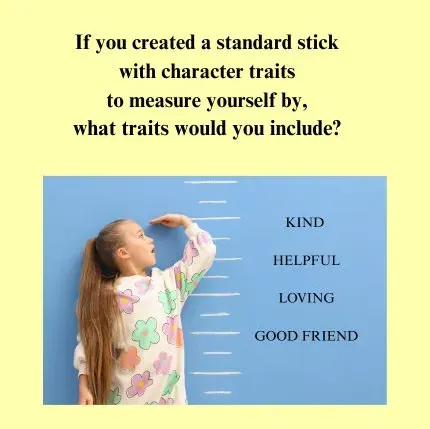
And I gave them an example. I let them know honesty would be high on my standard stick. I always want to tell the truth. I don’t want to be known as a liar. That example was enough.
Laughing, drawing pictures, and connecting fantastic character traits to their often-uneven hash marks started the hour with wild chatter and fun. But when they took turns presenting their standard sticks, reality sank in. These kids got it. Some students went above and beyond and included listening to their parents, cleaning their rooms, and taking better care of the dog.
Honesty, kindness, loving, were frequently listed.
On the dry-erase board, we created two columns. We captured everyone’s character traits and then went to the Bible and found the character traits of God. The kids were amazed to see how the two standard sticks meshed.
That was not the only point to this activity. I had to explain a very important message.
“I need to let you know the purpose of creating a personal standard stick is to keep us on the right path.
It is like a compass to guide us in the right way to live according to the matching standards of our heavenly Father who loves us.”
“You also need to know, what it isn’t. Our ruler is not a measuring tool to judge other people. Not everyone is kind, honest, or good. As long as we keep to our standard, our lives may help them see a better way to live. But remember, we are not to judge them or hurt them with hateful words and bitter attitudes.”
Today, differences exist. They can be hurtful and hateful. If we revise our personal measurement methods, revisit the characteristic traits on our standard stick, and if needed, realign our list with God’s list, life can be a bit sweeter for us all!
Blessings today and always,
Dr. Donna